Posts

Showing posts with the label Liver Fibrosis

Liver Fibrosis – Market Outlook, Epidemiology, Competitive Landscape, and Market Forecast Report – 2025 To 2035

Liver Fibrosis Market Outlook Thelansis’s “Liver Fibrosis Market Outlook, Epidemiology, Competitive Landscape, and Market Forecast Report – 2024 To 2034" covers disease overview, epidemiology, drug utilization, prescription share analysis, competitive landscape, clinical practice, regulatory landscape, patient share, market uptake, market forecast, and key market insights under the potential Liver Fibrosis treatment modalities options for eight major markets (USA, Germany, France, Italy, Spain, UK, Japan, and China). Key business questions answered: How can drug development and lifecycle management strategies be optimized across G8 markets (US, EU5, Japan, and China)? How large is the patient population in terms of incidence, prevalence, segments, and those receiving drug treatments? What is the 10-year market outlook for sales and patient share? Which events will have the greatest impact on the market’s trajectory? What insights do in...

Liver Fibrosis – Market Outlook, Epidemiology, Competitive Landscape, and Market Forecast Report – 2024 To 2034

Liver Fibrosis  Market Outlook Thelansis’s “Liver Fibrosis   Market Outlook, Epidemiology, Competitive Landscape, and Market Forecast Report – 2024 To 2034" covers disease overview, epidemiology, drug utilization, prescription share analysis, competitive landscape, clinical practice, regulatory landscape, patient share, market uptake, market forecast, and key market insights under the potential Liver Fibrosis   treatment modalities options for eight major markets (USA, Germany, France, Italy, Spain, UK, Japan, and China). Liver Fibrosis   Overview Liver fibrosis is an ineffective wound-healing process of the liver in response to repeated and chronic injury from many etiologies, such as infectious diseases like viral hepatitis, metabolic derangements (non-alcoholic steatohepatitis), exposure to toxins (e.g., alcohol liver diseases), or autoimmune diseases (e.g., primary biliary cirrhosis, primary sclerosing cholangitis, and autoimmune hepatitis). The morphology...

Liver Fibrosis – Market Outlook, Epidemiology, Competitive Landscape, and Market Forecast Report – 2023 To 2033

Image
  Liver fibrosis, an ineffective wound-healing process in the liver triggered by repeated and chronic injury from various causes such as infectious diseases (e.g., viral hepatitis), metabolic disorders (like nonalcoholic steatohepatitis), exposure to toxins (such as alcohol liver diseases), or autoimmune conditions (e.g., primary biliary cirrhosis, primary sclerosing cholangitis, and autoimmune hepatitis), is characterized by the accumulation of extracellular matrix (ECM) produced by myofibroblasts. In healthy livers, myofibroblasts are absent but accumulate in response to injury, serving as the primary effector cells in fibrogenesis. Crucial events in the pathogenesis of liver fibrosis include hepatocyte damage triggering inflammatory reactions and the subsequent activation of hepatic stellate cells (HSCs), which in their quiescent state in normal livers store retinoids and function as pericytes for sinusoidal endothelial cells. In March 2024, the FDA approved Rezdiffra (resmeti...

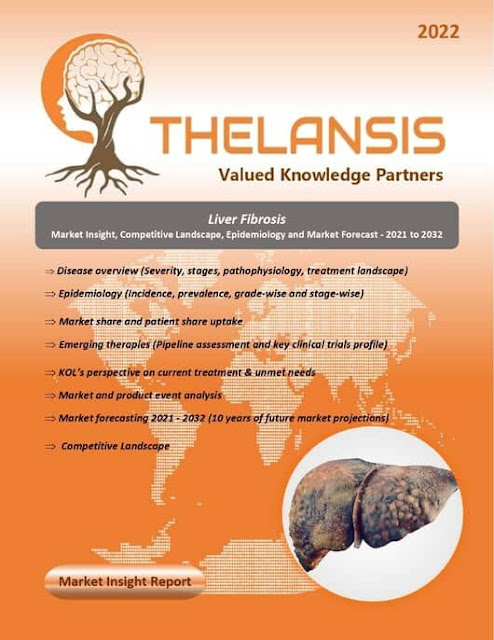
Liver Fibrosis Market Outlook, Epidemiology, Competitive Landscape, and Market Forecast Report – 2021 To 2032

Image
  Liver fibrosis is an ineffective wound-healing process of the liver in response to repeated and chronic injury from many etiologies, such as infectious diseases like viral hepatitis, metabolic derangements (non-alcoholic steatohepatitis), exposure to toxins (e.g., alcohol liver diseases), or autoimmune diseases (e.g., primary biliary cirrhosis, primary sclerosing cholangitis, and autoimmune hepatitis). The morphology characteristics of liver fibrosis are the deposition of extracellular matrix (ECM) produced by myofibroblasts. Myofibroblasts are absent from the healthy liver, accumulate in the injured liver, and serve as the principal effector cells of fibrogenesis. Several events are critical for the pathogenesis of liver fibrosis and its resolution. Damage to hepatocytes causes inflammatory reactions, which lead to the activation of hepatic stellate cells (HSCs). HSCs in the normal liver are in a quiescent state and function to store retinoids and serve as the pericytes for the ...

Liver Fibrosis – Market outlook, Epidemiology, Competitive Landscape, and Market Forecast Report – 2021 To 2032

Image
  Liver fibrosis is an ineffective wound-healing process of the liver in response to repeated and chronic injury from many etiologies, such as infectious diseases like viral hepatitis, metabolic derangements (non-alcoholic steatohepatitis), exposure to toxins (e.g., alcohol liver diseases), or autoimmune diseases (e.g., primary biliary cirrhosis, primary sclerosing cholangitis, and autoimmune hepatitis). The morphology characteristics of liver fibrosis are the deposition of extracellular matrix (ECM) produced by myofibroblasts. Myofibroblasts are absent from the healthy liver, accumulate in the injured liver, and serve as the principal effector cells of fibrogenesis. Several events are critical for the pathogenesis of liver fibrosis and its resolution. Damage to hepatocytes causes inflammatory reactions, which lead to the activation of hepatic stellate cells (HSCs). HSCs in the normal liver are in a quiescent state and function to store retinoids and serve as the pericytes for the ...