Posts

Showing posts with the label Testicular Cancer market outlook

Testicular Cancer – Market Outlook, Epidemiology, Competitive Landscape, and Market Forecast Report – 2025 To 2035

Testicular Cancer Market Outlook Thelansis’s “Testicular Cancer Market Outlook, Epidemiology, Competitive Landscape, and Market Forecast Report – 2024 To 2034" covers disease overview, epidemiology, drug utilization, prescription share analysis, competitive landscape, clinical practice, regulatory landscape, patient share, market uptake, market forecast, and key market insights under the potential Testicular Cancer treatment modalities options for eight major markets (USA, Germany, France, Italy, Spain, UK, Japan, and China). Key business questions answered: How can drug development and lifecycle management strategies be optimized across G8 markets (US, EU5, Japan, and China)? How large is the patient population in terms of incidence, prevalence, segments, and those receiving drug treatments? What is the 10-year market outlook for sales and patient share? Which events will have the greatest impact on the market’s trajectory? What insig...

Testicular Cancer – Market Outlook, Epidemiology, Competitive Landscape, and Market Forecast Report – 2024 To 2034

  Testicular Cancer Market Outlook Thelansis’s “Testicular Cancer Market Outlook, Epidemiology, Competitive Landscape, and Market Forecast Report – 2024 To 2034" covers disease overview, epidemiology, drug utilization, prescription share analysis, competitive landscape, clinical practice, regulatory landscape, patient share, market uptake, market forecast, and key market insights under the potential Testicular Cancer treatment modalities options for eight major markets (USA, Germany, France, Italy, Spain, UK, Japan, and China). Testicular Cancer Overview Testicular cancer, which primarily affects men between the ages of 15 and 45, is the most prevalent form of malignancy within this age group. When promptly identified and treated using a multimodal approach, it represents one of the most frequently curable types of cancer. Testicular cancer comprises approximately 1% of male tumors and 5% of urological malignancies. Epidemiological risk factors include cryptorchidism (undesc...

Testicular Cancer – Market Outlook, Epidemiology, Competitive Landscape, and Market Forecast Report – 2023 To 2033

Image
  Testicular cancer, which primarily affects men between the ages of 15 and 45, is the most prevalent form of malignancy within this age group. When promptly identified and treated using a multimodal approach, it represents one of the most frequently curable types of cancer. Testicular cancer comprises approximately 1% of male tumors and 5% of urological malignancies. Epidemiological risk factors include cryptorchidism (undescended testicles), impaired spermatogenesis leading to sub- or infertility, disorders of sexual development, a family history of testicular tumors among first-degree relatives, and the presence of a contralateral tumor or germ-cell neoplasia in-situ (GCNIS). Genetic alterations have been identified as significant risk factors in the etiology of testicular cancer. The presence of the isochromosome of the short arm of chromosome 12 (i12p) is a characteristic feature of all types of adult germ cell tumors (GCTs) and GCNIS. Approximately 66% of GCNIS cases exhibi...

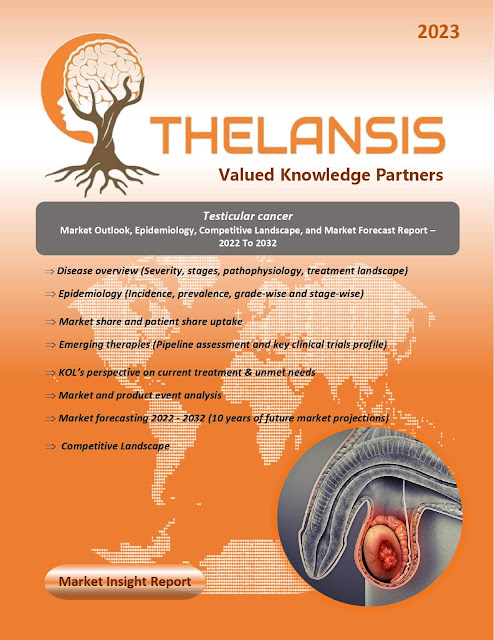
Testicular Cancer – Market Outlook, Epidemiology, Competitive Landscape, and Market Forecast Report – 2022 To 2032

Image
 Testicular cancer, which primarily affects men between the ages of 15 and 45, is the most prevalent form of malignancy within this age group. When promptly identified and treated using a multimodal approach, it represents one of the most frequently curable types of cancer. Testicular cancer comprises approximately 1% of male tumors and 5% of urological malignancies. Epidemiological risk factors include cryptorchidism (undescended testicles), impaired spermatogenesis leading to sub- or infertility, disorders of sexual development, a family history of testicular tumors among first-degree relatives, and the presence of a contralateral tumor or germ-cell neoplasia in-situ (GCNIS). Genetic alterations have been identified as significant risk factors in the etiology of testicular cancer. The presence of the isochromosome of the short arm of chromosome 12 (i12p) is a characteristic feature of all types of adult germ cell tumors (GCTs) and GCNIS. Approximately 66% of GCNIS cases exhibit a...