Posts

Showing posts with the label Gliosarcoma market outlook

Gliosarcoma – Market Outlook, Epidemiology, Competitive Landscape, and Market Forecast Report – 2025 To 2035

Gliosarcoma Market Outlook Thelansis’s “Gliosarcoma Market Outlook, Epidemiology, Competitive Landscape, and Market Forecast Report – 2024 To 2034" covers disease overview, epidemiology, drug utilization, prescription share analysis, competitive landscape, clinical practice, regulatory landscape, patient share, market uptake, market forecast, and key market insights under the potential Gliosarcoma treatment modalities options for eight major markets (USA, Germany, France, Italy, Spain, UK, Japan, and China). Key business questions answered: How can drug development and lifecycle management strategies be optimized across G8 markets (US, EU5, Japan, and China)? How large is the patient population in terms of incidence, prevalence, segments, and those receiving drug treatments? What is the 10-year market outlook for sales and patient share? Which events will have the greatest impact on the market’s trajectory? What insights do interviewed...

Gliosarcoma – Market Outlook, Epidemiology, Competitive Landscape, and Market Forecast Report – 2024 To 2034

Gliosarcoma Market Outlook Thelansis’s “Gliosarcoma Market Outlook, Epidemiology, Competitive Landscape, and Market Forecast Report – 2024 To 2034" covers disease overview, epidemiology, drug utilization, prescription share analysis, competitive landscape, clinical practice, regulatory landscape, patient share, market uptake, market forecast, and key market insights under the potential Gliosarcoma treatment modalities options for eight major markets (USA, Germany, France, Italy, Spain, UK, Japan, and China). Gliosarcoma Overview Gliosarcoma (GS) is a primary mixed tumor in the central nervous system that has a biphasic pattern consisting of glial and malignant mesenchymal elements. It manifests through various symptoms, including headaches, seizures, memory problems, thought process issues, movement difficulties, and numbness or weakness. The onset of GS is usually observed in individuals aged between the fourth and sixth decade of life, and the male/female ratio is 1.8/1. G...

Gliosarcoma – Market Outlook, Epidemiology, Competitive Landscape, and Market Forecast Report – 2023 To 2033

Image
  Gliosarcoma (GS) is a primary mixed tumor in the central nervous system that has a biphasic pattern consisting of glial and malignant mesenchymal elements. Gliosarcoma manifests through various symptoms, including headaches, seizures, memory problems, thought process issues, movement difficulties, and numbness or weakness. The onset of GS is usually observed in individuals aged between the fourth and sixth decade of life, and the male/female ratio is 1.8/1. Gliosarcomas are classified as Grade IV tumors, which grow rapidly and spread aggressively. They may be primary or secondary, based on their origin. Primary gliosarcomas originate in the central nervous system, while secondary gliosarcomas arise after the initial treatment of another glioblastoma, usually following radiation therapy. Gliosarcomas are rare, accounting for approximately 2% of all glioblastomas, and both tumor types are challenging to treat because they tend to grow aggressively and invade surrounding brain tis...

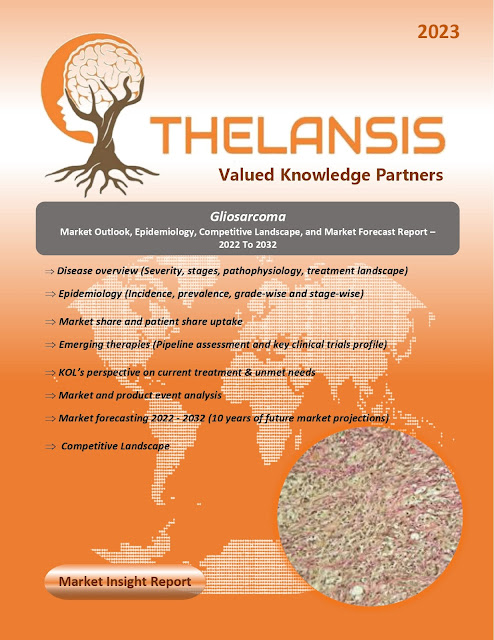
Gliosarcoma – Market Outlook, Epidemiology, Competitive Landscape, and Market Forecast Report – 2022 To 2032

Image
 Gliosarcoma (GS) is a primary mixed tumor in the central nervous system that has a biphasic pattern consisting of glial and malignant mesenchymal elements. It manifests through various symptoms, including headaches, seizures, memory problems, thought process issues, movement difficulties, and numbness or weakness. The onset of GS is usually observed in individuals aged between the fourth and sixth decade of life, and the male/female ratio is 1.8/1. Gliosarcomas are classified as Grade IV tumors, which grow rapidly and spread aggressively. They may be primary or secondary, based on their origin. Primary gliosarcomas originate in the central nervous system, while secondary gliosarcomas arise after the initial treatment of another glioblastoma, usually following radiation therapy. Gliosarcomas are rare, accounting for approximately 2% of all glioblastomas, and both tumor types are challenging to treat because they tend to grow aggressively and invade surrounding brain tissues. The tr...

Gliosarcoma – Market Outlook, Epidemiology, Competitive Landscape, and Market Forecast Report – 2022 To 2032

Image
 Gliosarcoma (GS) is a primary mixed tumor in the central nervous system that has a biphasic pattern consisting of glial and malignant mesenchymal elements. It manifests through various symptoms, including headaches, seizures, memory problems, thought process issues, movement difficulties, and numbness or weakness. The onset of GS is usually observed in individuals aged between the fourth and sixth decade of life, and the male/female ratio is 1.8/1. Gliosarcomas are classified as Grade IV tumors, which grow rapidly and spread aggressively. They may be primary or secondary, based on their origin. Primary gliosarcomas originate in the central nervous system, while secondary gliosarcomas arise after the initial treatment of another glioblastoma, usually following radiation therapy. Gliosarcomas are rare, accounting for approximately 2% of all glioblastomas, and both tumor types are challenging to treat because they tend to grow aggressively and invade surrounding brain tissues. The tr...