Posts

Showing posts with the label Epidermodysplasia verruciformis (EV) competitive landscape

Epidermodysplasia Verruciformis (EV) – Market Outlook, Epidemiology, Competitive Landscape, and Market Forecast Report – 2025 To 2035

Epidermodysplasia Verruciformis (EV) Market Outlook Thelansis’s “Epidermodysplasia Verruciformis (EV) Market Outlook, Epidemiology, Competitive Landscape, and Market Forecast Report – 2024 To 2034" covers disease overview, epidemiology, drug utilization, prescription share analysis, competitive landscape, clinical practice, regulatory landscape, patient share, market uptake, market forecast, and key market insights under the potential Epidermodysplasia Verruciformis (EV) treatment modalities options for eight major markets (USA, Germany, France, Italy, Spain, UK, Japan, and China). Key business questions answered: How can drug development and lifecycle management strategies be optimized across G8 markets (US, EU5, Japan, and China)? How large is the patient population in terms of incidence, prevalence, segments, and those receiving drug treatments? What is the 10-year market outlook for sales and patient share? Which events will have the grea...
Epidermodysplasia Verruciformis (EV) – Market Outlook, Epidemiology, Competitive Landscape, and Market Forecast Report – 2024 To 2034

Epidermodysplasia Verruciformis (EV) Market Outlook Thelansis’s “Epidermodysplasia Verruciformis (EV) Market Outlook, Epidemiology, Competitive Landscape, and Market Forecast Report – 2024 To 2034" covers disease overview, epidemiology, drug utilization, prescription share analysis, competitive landscape, clinical practice, regulatory landscape, patient share, market uptake, market forecast, and key market insights under the potential Epidermodysplasia Verruciformis (EV) treatment modalities options for eight major markets (USA, Germany, France, Italy, Spain, UK, Japan, and China). Epidermodysplasia Verruciformis (EV) Overview Epidermodysplasia verruciformis (EV) is a rare, lifelong, cutaneous, autosomal recessive immune system disorder characterized by increased susceptibility to cutaneous human papillomavirus (HPV) infection beginning in childhood. The disease usually manifests during infancy (7.5% of cases), youth (61.5% of cases), or puberty (22% of cases) with the prog...

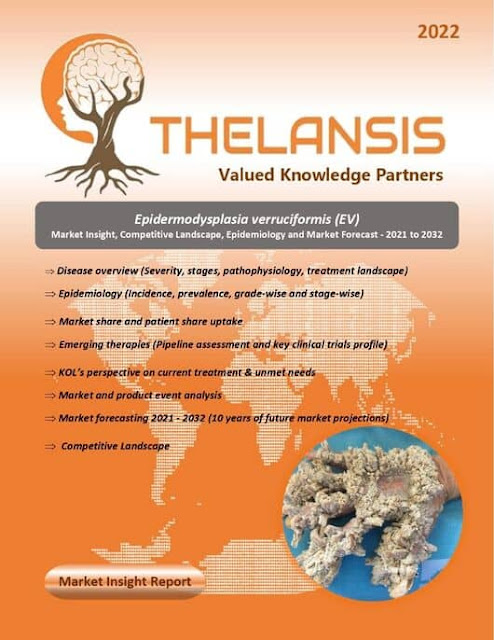
Epidermodysplasia verruciformis (EV) – Market outlook, Epidemiology, Competitive Landscape and Market Forecast Report – 2021 To 2032

Image
Epidermodysplasia verruciformis (EV) is a rare, lifelong, cutaneous, autosomal recessive immune system disorder characterized by increased susceptibility to cutaneous human papillomavirus (HPV) infection beginning in childhood. The disease usually manifests during infancy (7.5% of cases), youth (61.5% of cases), or puberty (22% of cases) with the progressive development of hyperpigmented or hypopigmented flat wart-like papules, irregular reddish-brown plaques, seborrheic keratosis-like lesions and pityriasis Versicolor-like macules on the trunk, neck, face, dorsal hands, and feet. Loss-of-function mutations can cause EV in either of two adjacent genes, EVER1/TMC6 or EVER2/TMC8 (17q25.3), which code for membrane proteins that form a complex with the zinc transporter protein ZnT-1 in the ER membrane of keratinocytes. In epidermodysplasia verruciformis, two clinical presentations have been described. Flat-topped papules and plaques with a scaly surface and irregular borders that are white...