Posts

Showing posts with the label Diabetic Kidney Disease market outlook

Diabetic Kidney Disease – Market Outlook, Epidemiology, Competitive Landscape, and Market Forecast Report – 2025 To 2035

Diabetic Kidney Disease Market Outlook Thelansis’s “Diabetic Kidney Disease Market Outlook, Epidemiology, Competitive Landscape, and Market Forecast Report – 2024 To 2034" covers disease overview, epidemiology, drug utilization, prescription share analysis, competitive landscape, clinical practice, regulatory landscape, patient share, market uptake, market forecast, and key market insights under the potential Diabetic Kidney Disease treatment modalities options for eight major markets (USA, Germany, France, Italy, Spain, UK, Japan, and China). Key business questions answered: How can drug development and lifecycle management strategies be optimized across G8 markets (US, EU5, Japan, and China)? How large is the patient population in terms of incidence, prevalence, segments, and those receiving drug treatments? What is the 10-year market outlook for sales and patient share? Which events will have the greatest impact on the market’s trajec...

Diabetic Kidney Disease – Market Outlook, Epidemiology, Competitive Landscape, and Market Forecast Report – 2024 To 2034

Diabetic Kidney Disease Market Outlook Thelansis’s “Diabetic Kidney Disease Market Outlook, Epidemiology, Competitive Landscape, and Market Forecast Report – 2024 To 2034" covers disease overview, epidemiology, drug utilization, prescription share analysis, competitive landscape, clinical practice, regulatory landscape, patient share, market uptake, market forecast, and key market insights under the potential Diabetic Kidney Disease treatment modalities options for eight major markets (USA, Germany, France, Italy, Spain, UK, Japan, and China). Diabetic Kidney Disease Overview Diabetic kidney disease (DKD) is a leading cause of end-stage kidney disease (ESKD), affecting approximately 40% of patients with type 1 and 2 diabetes. Diabetic nephropathy is the primary cause of kidney disease in patients who require renal replacement therapy. The exact cause of diabetic nephropathy remains unknown; however, insulin resistance, genetics, hyperglycemia, and autoimmune processes may co...

Diabetic Kidney Disease – Market Outlook, Epidemiology, Competitive Landscape, and Market Forecast Report – 2023 To 2033

Image
  Diabetic kidney disease (DKD) is a leading cause of end-stage kidney disease (ESKD), affecting approximately 40% of patients with type 1 and 2 diabetes. Diabetic nephropathy is the primary cause of kidney disease in patients who require renal replacement therapy. The exact cause of diabetic nephropathy remains unknown; however, insulin resistance, genetics, hyperglycemia, and autoimmune processes may contribute. Hyperglycemia causes the production of reactive oxygen species, which activate various pathways, including protein kinase C, hexosamine, polyol, and advanced glycation end products (AGE). The resulting inflammation is characterized by increased levels of cytokines and chemokines such as IL-6, MCP-1, TGF-beta, and VEGF, leading to fibrosis, inflammation, and increased vascular permeability. Chronic tubular injury and fibrosis occur as a result of epithelial-mesenchymal cell transformation. Albuminuria results from podocytopathy, and proteinuria occurs due to systemic and...

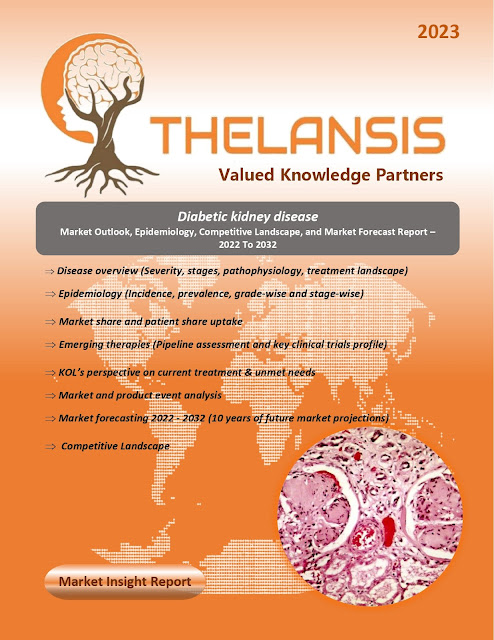
Diabetic Kidney Disease – Market Outlook, Epidemiology, Competitive Landscape, and Market Forecast Report – 2022 To 2032

Image
 Diabetic kidney disease (DKD) is a leading cause of end-stage kidney disease (ESKD), affecting approximately 40% of patients with type 1 and 2 diabetes. Diabetic nephropathy is the primary cause of kidney disease in patients who require renal replacement therapy. The exact cause of diabetic nephropathy remains unknown; however, insulin resistance, genetics, hyperglycemia, and autoimmune processes may contribute. Hyperglycemia causes the production of reactive oxygen species, which activate various pathways, including protein kinase C, hexosamine, polyol, and advanced glycation end products (AGE). The resulting inflammation is characterized by increased levels of cytokines and chemokines such as IL-6, MCP-1, TGF-beta, and VEGF, leading to fibrosis, inflammation, and increased vascular permeability. Chronic tubular injury and fibrosis occur as a result of epithelial-mesenchymal cell transformation. Albuminuria results from podocytopathy, and proteinuria occurs due to systemic and in...

Diabetic Kidney Disease – Market Outlook, Epidemiology, Competitive Landscape, and Market Forecast Report – 2022 To 2032

Image
 Diabetic kidney disease (DKD) is a leading cause of end-stage kidney disease (ESKD), affecting approximately 40% of patients with type 1 and 2 diabetes. Diabetic nephropathy is the primary cause of kidney disease in patients who require renal replacement therapy. The exact cause of diabetic nephropathy remains unknown; however, insulin resistance, genetics, hyperglycemia, and autoimmune processes may contribute. Hyperglycemia causes the production of reactive oxygen species, which activate various pathways, including protein kinase C, hexosamine, polyol, and advanced glycation end products (AGE). The resulting inflammation is characterized by increased levels of cytokines and chemokines such as IL-6, MCP-1, TGF-beta, and VEGF, leading to fibrosis, inflammation, and increased vascular permeability. Chronic tubular injury and fibrosis occur as a result of epithelial-mesenchymal cell transformation. Albuminuria results from podocytopathy, and proteinuria occurs due to systemic and in...