Posts

Showing posts with the label Graves’ Disease market forecast

Graves’ Disease – Market Outlook, Epidemiology, Competitive Landscape, and Market Forecast Report – 2025 To 2035

Graves’ Disease Market Outlook Thelansis’s “Graves’ Disease Market Outlook, Epidemiology, Competitive Landscape, and Market Forecast Report – 2024 To 2034" covers disease overview, epidemiology, drug utilization, prescription share analysis, competitive landscape, clinical practice, regulatory landscape, patient share, market uptake, market forecast, and key market insights under the potential Graves’ Disease treatment modalities options for eight major markets (USA, Germany, France, Italy, Spain, UK, Japan, and China). Key business questions answered: How can drug development and lifecycle management strategies be optimized across G8 markets (US, EU5, Japan, and China)? How large is the patient population in terms of incidence, prevalence, segments, and those receiving drug treatments? What is the 10-year market outlook for sales and patient share? Which events will have the greatest impact on the market’s trajectory? What insights do...
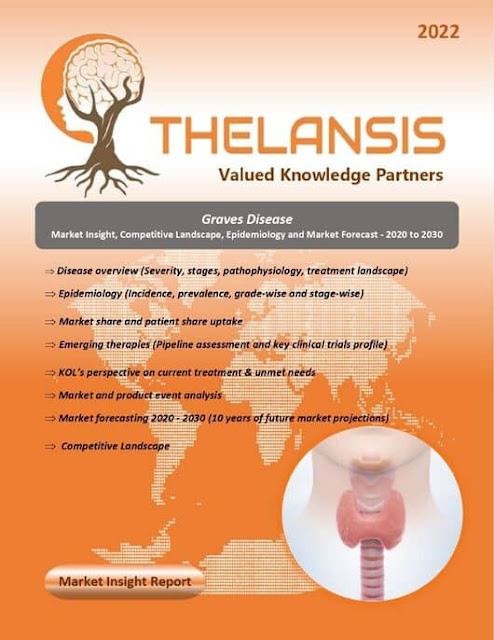
Graves’ Disease – Market outlook, Epidemiology, Competitive Landscape, and Market Forecast Report – 2020 To 2030

Image
  Graves' Disease is an autoimmune disorder that results in hyperthyroidism or an overactive thyroid. With this disease, the immune system attacks the thyroid and causes it to make more thyroid hormone than the body needs. The thyroid is a small, butterfly-shaped gland in the neck. Thyroid hormones control how the body uses energy, so they affect nearly every organ in your body, even the way your heartbeats. If left untreated, hyperthyroidism can cause serious heart, bones, muscles, menstrual cycle, and fertility problems. Untreated hyperthyroidism can cause complications for the mother and the baby during pregnancy. Graves' Disease can also have an impact on the eyes and skin. People who have other autoimmune disorders are more likely to develop Graves' Disease than those who do not. Rheumatoid arthritis, a condition that affects the joints and sometimes other body systems; pernicious anemia, an infection caused by a vitamin B12 deficiency; lupus, a chronic or long-term a ...