Posts

Showing posts with the label Iris Melanomas market forecast

Iris Melanomas – Market Outlook, Epidemiology, Competitive Landscape, and Market Forecast Report – 2025 To 2035

Iris Melanomas Market Outlook Thelansis’s “Iris Melanomas Market Outlook, Epidemiology, Competitive Landscape, and Market Forecast Report – 2024 To 2034" covers disease overview, epidemiology, drug utilization, prescription share analysis, competitive landscape, clinical practice, regulatory landscape, patient share, market uptake, market forecast, and key market insights under the potential Iris Melanomas treatment modalities options for eight major markets (USA, Germany, France, Italy, Spain, UK, Japan, and China). Key business questions answered: How can drug development and lifecycle management strategies be optimized across G8 markets (US, EU5, Japan, and China)? How large is the patient population in terms of incidence, prevalence, segments, and those receiving drug treatments? What is the 10-year market outlook for sales and patient share? Which events will have the greatest impact on the market’s trajectory? What insights do in...

Iris Melanomas – Market Outlook, Epidemiology, Competitive Landscape, and Market Forecast Report – 2024 To 2034

 Iris Melanomas Market Outlook Thelansis’s “Iris Melanomas Market Outlook, Epidemiology, Competitive Landscape, and Market Forecast Report – 2024 To 2034" covers disease overview, epidemiology, drug utilization, prescription share analysis, competitive landscape, clinical practice, regulatory landscape, patient share, market uptake, market forecast, and key market insights under the potential Iris Melanomas treatment modalities options for eight major markets (USA, Germany, France, Italy, Spain, UK, Japan, and China). Iris Melanomas Overview Iris melanomas originate from melanocytes found within the iris stroma. They tend to be more prevalent among individuals with light skin and blue irides. The majority (around 80 percent) of iris melanomas manifest in the lower quadrant of the iris. These tumors can exhibit diverse characteristics, ranging from well-defined to diffuse, with either lobular or flat growth patterns and varying pigmentation that spans from deeply pigmented to...

Iris Melanomas – Market Outlook, Epidemiology, Competitive Landscape, and Market Forecast Report – 2023 To 2033

Image
  Iris melanomas originate from melanocytes found within the iris stroma. They tend to be more prevalent among individuals with light skin and blue irides. The majority (around 80 percent) of iris melanomas manifest in the lower quadrant of the iris. These tumors can exhibit diverse characteristics, ranging from well-defined to diffuse, with either lobular or flat growth patterns and varying pigmentation that spans from deeply pigmented to lacking in pigment (amelanotic). The primary indicator of iris melanoma is a dark spot on the iris. Additional symptoms might encompass alterations in pupil shape, the perception of floaters, blurry vision, and ocular discomfort. Risk factors for developing iris melanoma contain fair skin, red or blond hair, and blue or green eyes, all of which correlate with fewer melanocytes. This malignancy also shows an elevated prevalence in individuals afflicted by the following conditions Atypical mole syndrome, Dysplastic nevus syndrome, and Ocular or o...

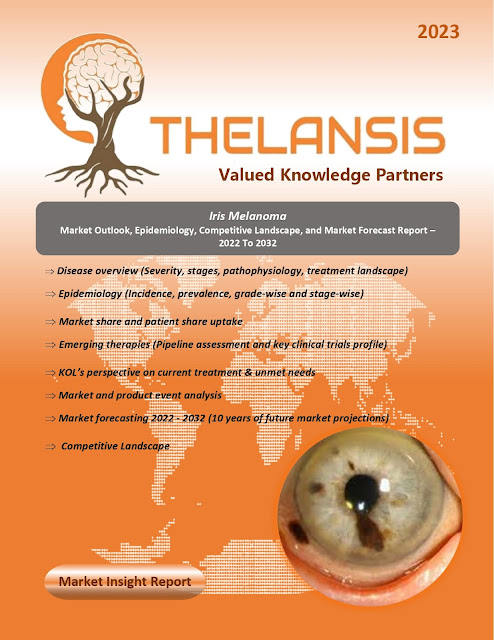
Iris Melanomas – Market Outlook, Epidemiology, Competitive Landscape, and Market Forecast Report – 2022 To 2032

Image
 Iris melanomas originate from melanocytes found within the iris stroma. They tend to be more prevalent among individuals with light skin and blue irides. The majority (around 80 percent) of iris melanomas manifest in the lower quadrant of the iris. These tumors can exhibit diverse characteristics, ranging from well-defined to diffuse, with either lobular or flat growth patterns and varying pigmentation that spans from deeply pigmented to lacking in pigment (amelanotic). The primary indicator of iris melanoma is a dark spot on the iris. Additional symptoms might encompass alterations in pupil shape, the perception of floaters, blurry vision, and ocular discomfort. Risk factors for developing iris melanoma contain fair skin, red or blond hair, and blue or green eyes, all of which correlate with fewer melanocytes. This malignancy also shows an elevated prevalence in individuals afflicted by the following conditions Atypical mole syndrome, Dysplastic nevus syndrome, and Ocular or ocul...