Posts

Showing posts with the label Anti-Glomerular Basement Membrane (anti-GBM) Disease

Anti-Glomerular Basement Membrane (anti-GBM) Disease – Market Outlook, Epidemiology, Competitive Landscape, and Market Forecast Report – 2025 To 2035

Anti-Glomerular Basement Membrane (anti-GBM) Disease Market Outlook Thelansis’s “Anti-Glomerular Basement Membrane (anti-GBM) Disease Market Outlook, Epidemiology, Competitive Landscape, and Market Forecast Report – 2024 To 2034" covers disease overview, epidemiology, drug utilization, prescription share analysis, competitive landscape, clinical practice, regulatory landscape, patient share, market uptake, market forecast, and key market insights under the potential Anti-Glomerular Basement Membrane (anti-GBM) Disease treatment modalities options for eight major markets (USA, Germany, France, Italy, Spain, UK, Japan, and China). Key business questions answered: How can drug development and lifecycle management strategies be optimized across G8 markets (US, EU5, Japan, and China)? How large is the patient population in terms of incidence, prevalence, segments, and those receiving drug treatments? What is the 10-year market outlook for sales and ...
Anti-Glomerular Basement Membrane (anti-GBM) Disease – Market Outlook, Epidemiology, Competitive Landscape, and Market Forecast Report – 2024 To 2034

Anti-Glomerular Basement Membrane (anti-GBM) Disease  Market Outlook Thelansis’s “Anti-Glomerular Basement Membrane (anti-GBM) Disease   Market Outlook, Epidemiology, Competitive Landscape, and Market Forecast Report – 2024 To 2034" covers disease overview, epidemiology, drug utilization, prescription share analysis, competitive landscape, clinical practice, regulatory landscape, patient share, market uptake, market forecast, and key market insights under the potential Anti-Glomerular Basement Membrane (anti-GBM) Disease   treatment modalities options for eight major markets (USA, Germany, France, Italy, Spain, UK, Japan, and China). Anti-Glomerular Basement Membrane (anti-GBM) Disease   Overview Anti-Glomerular Basement Membrane (anti-GBM) Disease is a rare form of small vessel vasculitis that affects the kidney and lung capillary beds. It is an archetypic autoimmune disease caused by the development of directly pathogenic autoantibodies targeting a well-char...

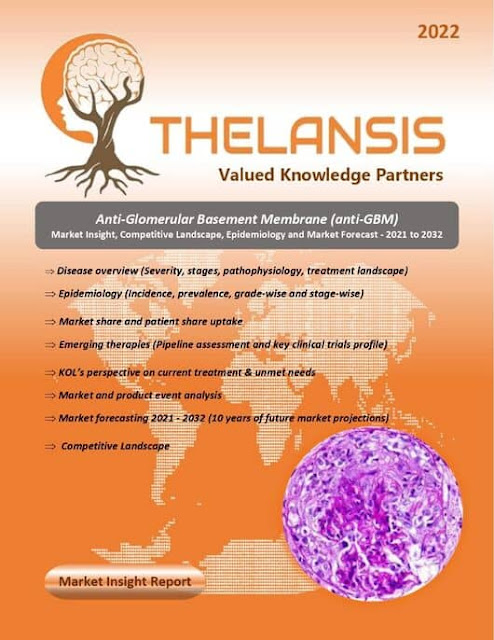
Anti-Glomerular Basement Membrane (anti-GBM) Disease – Market outlook, Epidemiology, Competitive Landscape, and Market Forecast Report – 2021 To 2032

Image
  Anti-Glomerular Basement Membrane (anti-GBM) Disease is a rare form of small vessel vasculitis that affects the kidney and lung capillary beds. It is an archetypic autoimmune disease caused by the development of directly pathogenic autoantibodies targeting a well-characterized autoantigen expressed in the basement membranes of these organs. The body creates autoantibodies that recognize and attach to the basement membrane, part of the wall of capillary blood vessels in the kidneys and lungs. Once the autoantibodies bind to the basement membrane, this creates a signal to the body’s immune system to attack. However, the inciting events that induce the autoimmune response. Environmental factors may trigger the disease in genetically susceptible individuals, such as the current infection. Most patients develop widespread glomerular crescent formation, presenting with signs and symptoms of rapidly progressing GN, and 40%–60% will have an alveolar hemorrhage at the same time. The treat...

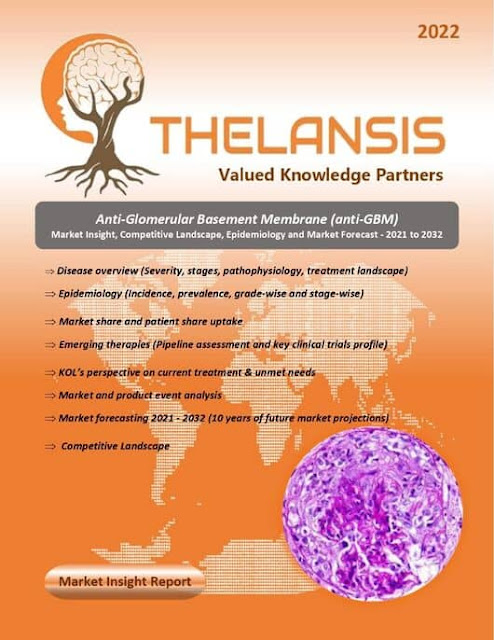
Anti-Glomerular Basement Membrane (anti-GBM) Disease – Market outlook, Epidemiology, Competitive Landscape, and Market Forecast Report – 2021 To 2032

Image
  Anti-Glomerular Basement Membrane (anti-GBM) Disease is a rare form of small vessel vasculitis that affects the kidney and lung capillary beds. It is an archetypic autoimmune disease caused by the development of directly pathogenic autoantibodies targeting a well-characterized autoantigen expressed in the basement membranes of these organs. The body creates autoantibodies that recognize and attach to the basement membrane, part of the wall of capillary blood vessels in the kidneys and lungs. Once the autoantibodies bind to the basement membrane, this creates a signal to the body’s immune system to attack. However, the inciting events that induce the autoimmune response. In genetically susceptible individuals, environmental factors, such as the current infection, may trigger the disease. Most patients develop widespread glomerular crescent formation, presenting with signs and symptoms of rapidly progressing GN, and 40%–60% will have an alveolar hemorrhage at the same time. The tre...