Posts

Showing posts with the label Extranodal NK/T-cell Lymphoma market outlook

Extranodal NK/T-cell Lymphoma – Market Outlook, Epidemiology, Competitive Landscape, and Market Forecast Report – 2025 To 2035

  Extranodal NK/T-cell Lymphoma Market Outlook Thelansis’s “Extranodal NK/T-cell Lymphoma Market Outlook, Epidemiology, Competitive Landscape, and Market Forecast Report – 2024 To 2034" covers disease overview, epidemiology, drug utilization, prescription share analysis, competitive landscape, clinical practice, regulatory landscape, patient share, market uptake, market forecast, and key market insights under the potential Extranodal NK/T-cell Lymphoma treatment modalities options for eight major markets (USA, Germany, France, Italy, Spain, UK, Japan, and China). Key business questions answered: How can drug development and lifecycle management strategies be optimized across G8 markets (US, EU5, Japan, and China)? How large is the patient population in terms of incidence, prevalence, segments, and those receiving drug treatments? What is the 10-year market outlook for sales and patient share? Which events will have the greatest impact on...

Extranodal NK/T-cell Lymphoma – Market Outlook, Epidemiology, Competitive Landscape, and Market Forecast Report – 2024 To 2034

Extranodal NK/T-cell Lymphoma Market Outlook Thelansis’s “Extranodal NK/T-cell Lymphoma Market Outlook, Epidemiology, Competitive Landscape, and Market Forecast Report – 2024 To 2034" covers disease overview, epidemiology, drug utilization, prescription share analysis, competitive landscape, clinical practice, regulatory landscape, patient share, market uptake, market forecast, and key market insights under the potential Extranodal NK/T-cell Lymphoma treatment modalities options for eight major markets (USA, Germany, France, Italy, Spain, UK, Japan, and China). Extranodal NK/T-cell Lymphoma Overview Extranodal NK/T-cell lymphoma is a rare form of non-Hodgkin lymphoma that is strongly linked to the Epstein-Barr virus (EBV). The most common cause of this so-called “lethal midline granuloma” manifests almost exclusively in non-nodal sites, most commonly as stage IE/IIE disease in the nose, nasopharynx, oropharynx, and upper aerodigestive tract. Other skin and gastrointestinal ...

Extranodal NK/T-cell Lymphoma – Market Outlook, Epidemiology, Competitive Landscape, and Market Forecast Report – 2023 To 2033

Image
  Extranodal NK/T-cell lymphoma is a rare form of non-Hodgkin lymphoma that is strongly linked to the Epstein-Barr virus (EBV). The most common cause of this so-called "lethal midline granuloma" manifests almost exclusively in non-nodal sites, most commonly as stage IE/IIE disease in the nose, nasopharynx, oropharynx, and upper aerodigestive tract. Other skin and gastrointestinal tract sites can be involved in more advanced stages. Lymph nodes may have secondary involvement but are generally not the disease's primary site. Given the typical anatomic sites of involvement, the majority of patients present with nasal obstruction or epistaxis; some present with destructive masses involving the nose, sinuses, or palate. Approximately 3% of patients with ENKTL present with hemophagocytic lymphohistiocytosis syndrome characterized by high fevers, cytopenia, abnormal liver function tests, and high ferritin levels due to pathologic immune activation. The typical immunophenotype ...

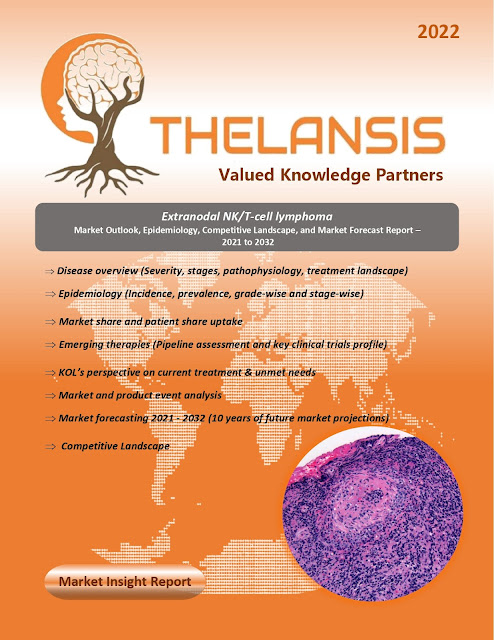
Extranodal NK/T-cell Lymphoma – Market Outlook, Epidemiology, Competitive Landscape, and Market Forecast Report – 2021 To 2032

Image
Extranodal NK/T-cell lymphoma is a rare form of non-Hodgkin lymphoma that is strongly linked to the Epstein-Barr virus (EBV). The most common cause of this so-called "lethal midline granuloma" manifests almost exclusively in non-nodal sites, most commonly as stage IE/IIE disease in the nose, nasopharynx, oropharynx, and upper aerodigestive tract. Other skin and gastrointestinal tract sites can be involved in more advanced stages. Lymph nodes may have secondary involvement but are generally not the disease's primary site. Given the typical anatomic sites of involvement, the majority of patients present with nasal obstruction or epistaxis; some present with destructive masses involving the nose, sinuses, or palate. Approximately 3% of patients with ENKTL present with hemophagocytic lymphohistiocytosis syndrome characterised by high fevers, cytopenia, abnormal liver function tests, and high ferritin levels due to pathologic immune activation. The typical immunophenotype of E...