Posts

Showing posts with the label Hemophilia competitive landscape

Hemophilia – Market Outlook, Epidemiology, Competitive Landscape, and Market Forecast Report – 2025 To 2035

Hemophilia Market Outlook Thelansis’s “Hemophilia Market Outlook, Epidemiology, Competitive Landscape, and Market Forecast Report – 2024 To 2034" covers disease overview, epidemiology, drug utilization, prescription share analysis, competitive landscape, clinical practice, regulatory landscape, patient share, market uptake, market forecast, and key market insights under the potential Hemophilia treatment modalities options for eight major markets (USA, Germany, France, Italy, Spain, UK, Japan, and China). Key business questions answered: How can drug development and lifecycle management strategies be optimized across G8 markets (US, EU5, Japan, and China)? How large is the patient population in terms of incidence, prevalence, segments, and those receiving drug treatments? What is the 10-year market outlook for sales and patient share? Which events will have the greatest impact on the market’s trajectory? What insights do interviewed ex...

Hemophilia – Market Outlook, Epidemiology, Competitive Landscape, and Market Forecast Report – 2024 To 2034

  Hemophilia Market Outlook Thelansis’s “Hemophilia Market Outlook, Epidemiology, Competitive Landscape, and Market Forecast Report – 2024 To 2034" covers disease overview, epidemiology, drug utilization, prescription share analysis, competitive landscape, clinical practice, regulatory landscape, patient share, market uptake, market forecast, and key market insights under the potential Hemophilia treatment modalities options for eight major markets (USA, Germany, France, Italy, Spain, UK, Japan, and China). Hemophilia Overview Hemophilia is a severe hereditary hemorrhagic disorder, with significant types of hemophilia A (classic hemophilia or factor VIII deficiency) and hemophilia B (also known as Christmas disease or factor IX deficiency). The disorder is inherited and is characterized by a deficiency of clotting factors in the blood. Hemophilia C is a rare condition caused by a deficiency of clotting factor XI. Approximately 25% of hemophilia A cases are caused by gross ge...

Hemophilia – Market Outlook, Epidemiology, Competitive Landscape, and Market Forecast Report – 2023 To 2033

Image
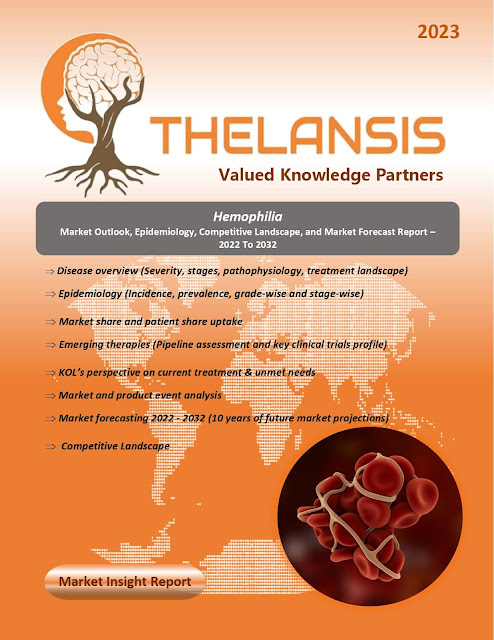
 Hemophilia is a severe hereditary hemorrhagic disorder, with significant types of hemophilia A (classic hemophilia or factor VIII deficiency) and hemophilia B (also known as Christmas disease or factor IX deficiency). The disorder is inherited and is characterized by a deficiency of clotting factors in the blood. Hemophilia C is a rare condition caused by a deficiency of clotting factor XI. Approximately 25% of hemophilia A cases are caused by gross gene rearrangements, with 5% due to gross gene deletions and 20% to inversions of a 500-600 kb segment that breaks intron 22 of the F8 gene. Hemophilia B cases due to gross rearrangements of F9 are less than 2%. F9 mutations occur more frequently in male germline than in female germline. Hemophilia can manifest in mild, moderate, and severe forms, depending on the blood level or amount of clotting factor and the patient's symptoms. Mild hemophilia involves having 6-49% of the normal factor level, with bleeding typically occurring only ...

Hemophilia – Market Outlook, Epidemiology, Competitive Landscape, and Market Forecast Report – 2022 To 2032

Image
  Indication name: Hemophilia Hemophilia is a severe hereditary hemorrhagic disorder, with significant types of haemophilia A (also known as classic haemophilia or factor VIII deficiency) and haemophilia B (also known as Christmas disease or factor IX deficiency). The disorder is inherited and is characterized by a deficiency of clotting factors in the blood. Hemophilia C is a rare condition caused by a deficiency of clotting factor XI. Approximately 25% of haemophilia A cases are caused by gross gene rearrangements, with 5% due to gross gene deletions and 20% to inversions of a 500-600 kb segment that breaks intron 22 of the F8 gene. Hemophilia B cases due to gross rearrangements of F9 are less than 2%. F9 mutations occur more frequently in male germline than in female germline. Hemophilia can manifest in mild, moderate, and severe forms, depending on the blood level or amount of clotting factor and the patient's symptoms. Mild haemophilia involves having 6-49% of the normal fa...

Hemophilia – Market Outlook, Epidemiology, Competitive Landscape, and Market Forecast Report – 2022 To 2032

Image
 Hemophilia is a severe hereditary hemorrhagic disorder, with significant types of haemophilia A (also known as classic haemophilia or factor VIII deficiency) and haemophilia B (also known as Christmas disease or factor IX deficiency). The disorder is inherited and is characterized by a deficiency of clotting factors in the blood. Hemophilia C is a rare condition caused by a deficiency of clotting factor XI. Approximately 25% of haemophilia A cases are caused by gross gene rearrangements, with 5% due to gross gene deletions and 20% to inversions of a 500-600 kb segment that breaks intron 22 of the F8 gene. Hemophilia B cases due to gross rearrangements of F9 are less than 2%. F9 mutations occur more frequently in male germline than in female germline. Hemophilia can manifest in mild, moderate, and severe forms, depending on the blood level or amount of clotting factor and the patient's symptoms. Mild haemophilia involves having 6-49% of the normal factor level, with bleeding typica...

Hemophilia – Market Outlook, Epidemiology, Competitive Landscape, and Market Forecast Report – 2022 To 2032

Image
Hemophilia is a severe hereditary hemorrhagic disorder, with significant types of haemophilia A (also known as classic haemophilia or factor VIII deficiency) and haemophilia B (also known as Christmas disease or factor IX deficiency). The disorder is inherited and is characterized by a deficiency of clotting factors in the blood. Hemophilia C is a rare condition caused by a deficiency of clotting factor XI. Approximately 25% of haemophilia A cases are caused by gross gene rearrangements, with 5% due to gross gene deletions and 20% to inversions of a 500-600 kb segment that breaks intron 22 of the F8 gene. Hemophilia B cases due to gross rearrangements of F9 are less than 2%. F9 mutations occur more frequently in male germline than in female germline. Hemophilia can manifest in mild, moderate, and severe forms, depending on the blood level or amount of clotting factor and the patient's symptoms. Mild haemophilia involves having 6-49% of the normal factor level, with bleeding typical...