Posts

Showing posts with the label Neurofibromas market outlook

Neurofibromas – Market Outlook, Epidemiology, Competitive Landscape, and Market Forecast Report – 2025 To 2035

Neurofibromas Market Outlook Thelansis’s “Neurofibromas Market Outlook, Epidemiology, Competitive Landscape, and Market Forecast Report – 2024 To 2034" covers disease overview, epidemiology, drug utilization, prescription share analysis, competitive landscape, clinical practice, regulatory landscape, patient share, market uptake, market forecast, and key market insights under the potential Neurofibromas treatment modalities options for eight major markets (USA, Germany, France, Italy, Spain, UK, Japan, and China). Key business questions answered: How can drug development and lifecycle management strategies be optimized across G8 markets (US, EU5, Japan, and China)? How large is the patient population in terms of incidence, prevalence, segments, and those receiving drug treatments? What is the 10-year market outlook for sales and patient share? Which events will have the greatest impact on the market’s trajectory? What insights do inter...

Neurofibromas – Market Outlook, Epidemiology, Competitive Landscape, and Market Forecast Report – 2024 To 2034

  Neurofibromas Market Outlook Thelansis’s “Neurofibromas Market Outlook, Epidemiology, Competitive Landscape, and Market Forecast Report – 2024 To 2034" covers disease overview, epidemiology, drug utilization, prescription share analysis, competitive landscape, clinical practice, regulatory landscape, patient share, market uptake, market forecast, and key market insights under the potential Neurofibromas treatment modalities options for eight major markets (USA, Germany, France, Italy, Spain, UK, Japan, and China). Neurofibromas Overview Neurofibromas are benign nerve sheath tumors composed of differentiated neoplastic Schwann cells and a mixture of nonneoplastic components. These tumors can present as nodular and well-demarcated or diffuse growths. Intraneural neurofibromas typically grow along the nerve confined within its epineurium. The main cellular constituents of neurofibromas are neoplastic Schwann cells, characterized by small, curved, or elongated nuclei, along wi...

Neurofibromas – Market Outlook, Epidemiology, Competitive Landscape, and Market Forecast Report – 2023 To 2033

Image
  Neurofibromas are benign nerve sheath tumors composed of differentiated neoplastic Schwann cells and a mixture of nonneoplastic components. These tumors can present as nodular and well-demarcated or diffuse growths. Intraneural neurofibromas typically grow along the nerve confined within its epineurium. The main cellular constituents of neurofibromas are neoplastic Schwann cells, characterized by small, curved, or elongated nuclei, along with fibroblasts embedded within a myxoid/collagenic matrix in varying proportions. While neurofibromas may exhibit focal resemblance to Antoni B pattern, they lack Antoni A pattern and hyalinized blood vessels, distinguishing them from schwannomas. The Schwann cell component in neurofibromas shows expression of S100 and SOX10 proteins. Both sporadic and syndromic neurofibromas are associated with a deletion in the NF1 gene. Sporadic cases only involve the lesional cells carrying the NF1 mutation, while syndromic cases result from a germline mu...

Neurofibromas – Market Outlook, Epidemiology, Competitive Landscape, and Market Forecast Report – 2022 To 2032

Image
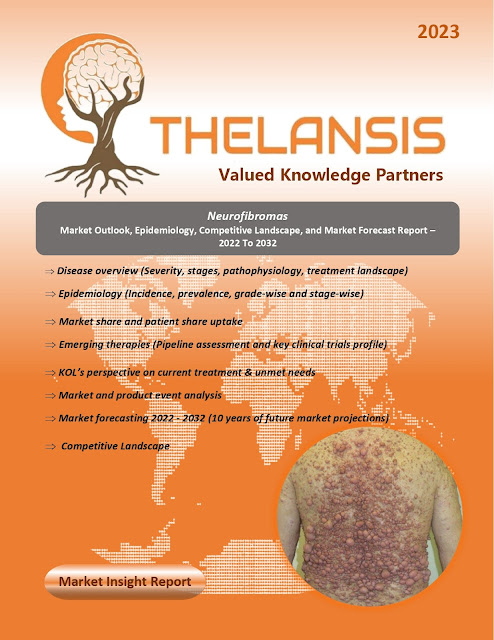
 Neurofibromas are benign nerve sheath tumors composed of differentiated neoplastic Schwann cells and a mixture of nonneoplastic components. These tumors can present as nodular and well-demarcated or diffuse growths. Intraneural neurofibromas typically grow along the nerve confined within its epineurium. The main cellular constituents of neurofibromas are neoplastic Schwann cells, characterized by small, curved, or elongated nuclei, along with fibroblasts embedded within a myxoid/collagenic matrix in varying proportions. While neurofibromas may exhibit focal resemblance to Antoni B pattern, they lack Antoni A pattern and hyalinized blood vessels, distinguishing them from schwannomas. The Schwann cell component in neurofibromas shows expression of S100 and SOX10 proteins. Both sporadic and syndromic neurofibromas are associated with a deletion in the NF1 gene. Sporadic cases only involve the lesional cells carrying the NF1 mutation, while syndromic cases result from a germline mutat...