Posts

Showing posts with the label Herpetic simplex keratitis competitive landscape

Herpetic Simplex keratitis – Market Outlook, Epidemiology, Competitive Landscape, and Market Forecast Report – 2025 To 2035

Herpetic Simplex keratitis Market Outlook Thelansis’s “Herpetic Simplex keratitis Market Outlook, Epidemiology, Competitive Landscape, and Market Forecast Report – 2024 To 2034" covers disease overview, epidemiology, drug utilization, prescription share analysis, competitive landscape, clinical practice, regulatory landscape, patient share, market uptake, market forecast, and key market insights under the potential Herpetic Simplex keratitis treatment modalities options for eight major markets (USA, Germany, France, Italy, Spain, UK, Japan, and China). Key business questions answered: How can drug development and lifecycle management strategies be optimized across G8 markets (US, EU5, Japan, and China)? How large is the patient population in terms of incidence, prevalence, segments, and those receiving drug treatments? What is the 10-year market outlook for sales and patient share? Which events will have the greatest impact on the market...

Herpetic Simplex keratitis – Market Outlook, Epidemiology, Competitive Landscape, and Market Forecast Report – 2023 To 2033

Image
 A herpetic simplex keratitis is a form of keratitis caused by recurrent herpes simplex virus (HSV) infection in the cornea. It begins with the infection of epithelial cells on the eye's surface and retrograde infection of nerves serving the cornea. Primary infection is characterized by swelling of the conjunctiva and eyelids (Blepharoconjunctivitis) and small white itchy lesions on the corneal surface. The severity of the lesions varies, ranging from minor epithelial damage (superficial punctate keratitis) to more severe consequences such as the formation of dendritic ulcers. Humans are commonly infected with HSV. It is estimated that one-third of the world's population is infected regularly. Keratitis caused by HSV is the leading cause of corneal blindness in developed countries. As a result, HSV infections are a significant and global public health issue. Herpes simplex virus (HSV) is a ubiquitous DNA virus that can infect virtually anywhere in the body, particularly when ne...

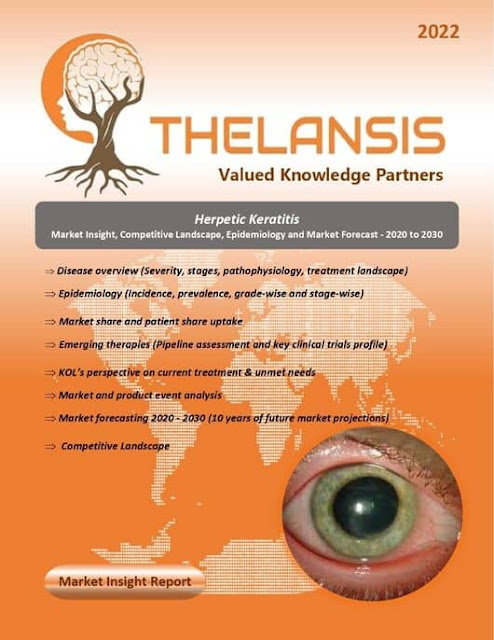
Herpetic simplex keratitis – Market outlook, Epidemiology, Competitive Landscape, and Market Forecast Report – 2020 To 2030

Image
  A herpetic simplex keratitis is a form of keratitis caused by recurrent herpes simplex virus (HSV) infection in the cornea. It begins with the infection of epithelial cells on the eye's surface and retrograde infection of nerves serving the cornea. Primary infection is characterized by swelling of the conjunctiva and eyelids (Blepharoconjunctivitis) and small white itchy lesions on the corneal surface. The severity of the lesions varies, ranging from minor epithelial damage (superficial punctate keratitis) to more severe consequences such as the formation of dendritic ulcers. Humans are commonly infected with HSV. It is estimated that one-third of the world's population is infected regularly. Keratitis caused by HSV is the leading cause of corneal blindness in developed countries. As a result, HSV infections are a significant global public health issue. Herpes simplex virus (HSV) is a ubiquitous DNA virus that can infect virtually anywhere in the body, particularly when newbo...