Posts

Showing posts with the label Fallopian Tube Cancer market outlook

Fallopian Tube Cancer – Market Outlook, Epidemiology, Competitive Landscape, and Market Forecast Report – 2025 To 2035

Fallopian Tube Cancer Market Outlook Thelansis’s “Fallopian Tube Cancer Market Outlook, Epidemiology, Competitive Landscape, and Market Forecast Report – 2024 To 2034" covers disease overview, epidemiology, drug utilization, prescription share analysis, competitive landscape, clinical practice, regulatory landscape, patient share, market uptake, market forecast, and key market insights under the potential Fallopian Tube Cancer treatment modalities options for eight major markets (USA, Germany, France, Italy, Spain, UK, Japan, and China). Key business questions answered: How can drug development and lifecycle management strategies be optimized across G8 markets (US, EU5, Japan, and China)? How large is the patient population in terms of incidence, prevalence, segments, and those receiving drug treatments? What is the 10-year market outlook for sales and patient share? Which events will have the greatest impact on the market’s trajectory? ...

Fallopian Tube Cancer – Market Outlook, Epidemiology, Competitive Landscape, and Market Forecast Report – 2024 To 2034

Fallopian Tube Cancer Market Outlook Thelansis’s “Fallopian Tube Cancer Market Outlook, Epidemiology, Competitive Landscape, and Market Forecast Report – 2024 To 2034" covers disease overview, epidemiology, drug utilization, prescription share analysis, competitive landscape, clinical practice, regulatory landscape, patient share, market uptake, market forecast, and key market insights under the potential Fallopian Tube Cancer treatment modalities options for eight major markets (USA, Germany, France, Italy, Spain, UK, Japan, and China). Fallopian Tube Cancer Overview Primary fallopian tube carcinoma (PFTC) is rare cancer that arises from the transformation of the salpingeal mucosa, or the cells lining the fallopian tubes. The exact cause of PFTC is unknown, but hormonal, reproductive, and genetic factors, as well as deleterious mutations in the BRCA1 or BRCA2 genes, are thought to increase the risk of this disease. The most common type of PFTC is papillary serous adenocarci...

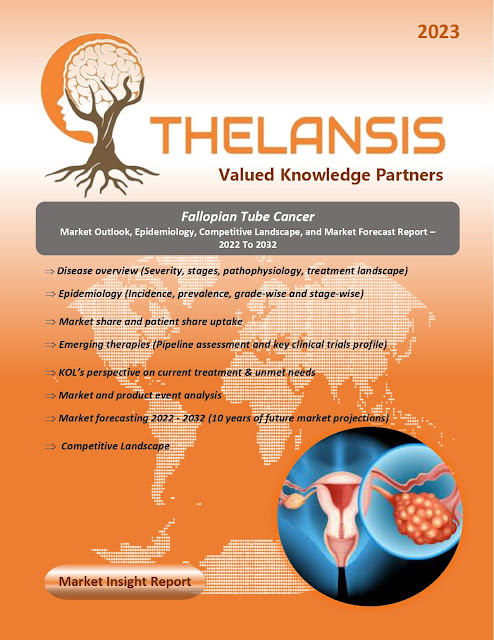
Fallopian Tube Cancer – Market Outlook, Epidemiology, Competitive Landscape, and Market Forecast Report – 2023 To 2033

Image
  Primary fallopian tube carcinoma (PFTC) is a rare cancer that arises from the transformation of the salpingeal mucosa, or the cells lining the fallopian tubes. The exact cause of PFTC is unknown, but hormonal, reproductive, and genetic factors, as well as deleterious mutations in the BRCA1 or BRCA2 genes, are thought to increase the risk of this disease. The most common type of PFTC is papillary serous adenocarcinoma, which represents more than 95% of fallopian tube cancers. Other types of PFTC include sarcomas (leiomyosarcomas) and transitional cell carcinomas. PFTC typically occurs between the ages of 40 and 60, with a median age of 55. Symptoms of PFTC include irregular vaginal bleeding or discharge, lower abdominal pain, bloating, and pelvic pressure. Pain, which may be relieved with the passage of blood or discharge, is a commonly reported symptom. The 5-year survival rate for patients with stage III-IV disease is 55% if the residual tumor is less than 1 cm in diameter, co...

Fallopian Tube Cancer – Market Outlook, Epidemiology, Competitive Landscape, and Market Forecast Report – 2022 To 2032

Image
 Primary fallopian tube carcinoma (PFTC) is rare cancer that arises from the transformation of the salpingeal mucosa, or the cells lining the fallopian tubes. The exact cause of PFTC is unknown, but hormonal, reproductive, and genetic factors, as well as deleterious mutations in the BRCA1 or BRCA2 genes, are thought to increase the risk of this disease. The most common type of PFTC is papillary serous adenocarcinoma, which represents more than 95% of fallopian tube cancers. Other types of PFTC include sarcomas (leiomyosarcomas) and transitional cell carcinomas. PFTC typically occurs between the ages of 40 and 60, with a median age of 55. Symptoms of PFTC include irregular vaginal bleeding or discharge, lower abdominal pain, bloating, and pelvic pressure. Pain, which may be relieved with the passage of blood or discharge, is a commonly reported symptom. The 5-year survival rate for patients with stage III-IV disease is 55% if the residual tumor is less than 1 cm in diameter, compare...

Fallopian Tube Cancer – Market Outlook, Epidemiology, Competitive Landscape, and Market Forecast Report – 2022 To 2032

Image
 Primary fallopian tube carcinoma (PFTC) is rare cancer that arises from the transformation of the salpingeal mucosa, or the cells lining the fallopian tubes. The exact cause of PFTC is unknown, but hormonal, reproductive, and genetic factors, as well as deleterious mutations in the BRCA1 or BRCA2 genes, are thought to increase the risk of this disease. The most common type of PFTC is papillary serous adenocarcinoma, which represents more than 95% of fallopian tube cancers. Other types of PFTC include sarcomas (leiomyosarcomas) and transitional cell carcinomas. PFTC typically occurs between the ages of 40 and 60, with a median age of 55. Symptoms of PFTC include irregular vaginal bleeding or discharge, lower abdominal pain, bloating, and pelvic pressure. Pain, which may be relieved with the passage of blood or discharge, is a commonly reported symptom. The 5-year survival rate for patients with stage III-IV disease is 55% if the residual tumor is less than 1 cm in diameter, compare...