Posts

Showing posts with the label Ventilator-Associated Pneumonia (VAP) market outlook

Ventilator-Associated Pneumonia (VAP) – Market Outlook, Epidemiology, Competitive Landscape, and Market Forecast Report – 2025 To 2035

Ventilator-Associated Pneumonia (VAP) Market Outlook Thelansis’s “Ventilator-Associated Pneumonia (VAP) Market Outlook, Epidemiology, Competitive Landscape, and Market Forecast Report – 2024 To 2034" covers disease overview, epidemiology, drug utilization, prescription share analysis, competitive landscape, clinical practice, regulatory landscape, patient share, market uptake, market forecast, and key market insights under the potential Ventilator-Associated Pneumonia (VAP) treatment modalities options for eight major markets (USA, Germany, France, Italy, Spain, UK, Japan, and China). Key business questions answered: How can drug development and lifecycle management strategies be optimized across G8 markets (US, EU5, Japan, and China)? How large is the patient population in terms of incidence, prevalence, segments, and those receiving drug treatments? What is the 10-year market outlook for sales and patient share? Which events will have the g...

Ventilator-Associated Pneumonia (VAP) – Market Outlook, Epidemiology, Competitive Landscape, and Market Forecast Report – 2024 To 2034

Ventilator-Associated Pneumonia (VAP) Market Outlook Thelansis’s “Ventilator-Associated Pneumonia (VAP) Market Outlook, Epidemiology, Competitive Landscape, and Market Forecast Report – 2024 To 2034" covers disease overview, epidemiology, drug utilization, prescription share analysis, competitive landscape, clinical practice, regulatory landscape, patient share, market uptake, market forecast, and key market insights under the potential Ventilator-Associated Pneumonia (VAP) treatment modalities options for eight major markets (USA, Germany, France, Italy, Spain, UK, Japan, and China). Ventilator-Associated Pneumonia (VAP) Overview Ventilator-associated pneumonia (VAP) is pneumonia or infection in lung parenchyma acquired in patients after invasive mechanical ventilation after 48–72 hours. New or progressive infiltrates, systemic disease (fever, altered white blood cell counts), changes in sputum characteristics, and the detection of a causative agent are seen in VAP patient...

Ventilator-Associated Pneumonia (VAP) – Market Outlook, Epidemiology, Competitive Landscape, and Market Forecast Report – 2023 To 2033

Image
  Ventilator-associated pneumonia (VAP) is pneumonia or infection in lung parenchyma acquired in patients after invasive mechanical ventilation after 48–72 hours. New or progressive infiltrates, systemic disease (fever, altered white blood cell counts), changes in sputum characteristics, and the detection of a causative agent are seen in VAP patients. VAP is the most common ICU-acquired pneumonia among invasive mechanically ventilated patients. VAP is recognized as a significant issue worldwide and a common healthcare-associated infection (HAI) among developing countries associated with mortality, a longer length of stay, and associated cost burden among patients. The VAP rate varies across studies due to differences in diagnostic criteria, ICUs type, patients' characteristics, and also varying causative microorganisms associated with patients' characteristics, length of stay, and antibiotic use in hospitals. Oropharyngeal and gastric colonization, therma...

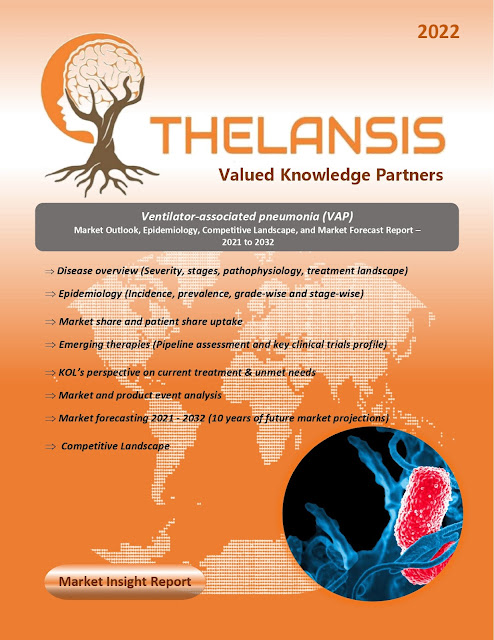
Ventilator-Associated Pneumonia (VAP) – Market Outlook, Epidemiology, Competitive Landscape, and Market Forecast Report – 2021 To 2032

Image
Ventilator-associated pneumonia (VAP) is pneumonia or infection in lung parenchyma acquired in patients after invasive mechanical ventilation after 48–72 hours. New or progressive infiltrates, systemic disease (fever, altered white blood cell counts), changes in sputum characteristics, and the detection of a causative agent are seen in VAP patients. VAP is the most common ICU-acquired pneumonia among invasive mechanically ventilated patients. VAP is recognized as a significant issue worldwide and a common healthcare-associated infection (HAI) among developing countries associated with mortality, a longer length of stay, and associated cost burden among patients. The VAP rate varies across studies due to differences in diagnostic criteria, ICUs type, patients' characteristics, and also varying causative microorganisms associated with patients' characteristics, length of stay, and antibiotic use in hospitals. Oropharyngeal and gastric colonization, thermal injuries; posttraumatic...