Posts

Showing posts with the label Psoriatic Arthritis (PsA)

Psoriatic Arthritis (PsA) – Market Outlook, Epidemiology, Competitive Landscape, and Market Forecast Report – 2025 To 2035

Psoriatic Arthritis (PsA) Market Outlook Thelansis’s “Psoriatic Arthritis (PsA) Market Outlook, Epidemiology, Competitive Landscape, and Market Forecast Report – 2024 To 2034" covers disease overview, epidemiology, drug utilization, prescription share analysis, competitive landscape, clinical practice, regulatory landscape, patient share, market uptake, market forecast, and key market insights under the potential Psoriatic Arthritis (PsA) treatment modalities options for eight major markets (USA, Germany, France, Italy, Spain, UK, Japan, and China). Key business questions answered: How can drug development and lifecycle management strategies be optimized across G8 markets (US, EU5, Japan, and China)? How large is the patient population in terms of incidence, prevalence, segments, and those receiving drug treatments? What is the 10-year market outlook for sales and patient share? Which events will have the greatest impact on the market’s ...

Psoriatic Arthritis (PsA) – Market Outlook, Epidemiology, Competitive Landscape, and Market Forecast Report – 2024 To 2034

Psoriatic Arthritis (PsA) Market Outlook Thelansis’s “Psoriatic Arthritis (PsA) Market Outlook, Epidemiology, Competitive Landscape, and Market Forecast Report – 2024 To 2034" covers disease overview, epidemiology, drug utilization, prescription share analysis, competitive landscape, clinical practice, regulatory landscape, patient share, market uptake, market forecast, and key market insights under the potential Psoriatic Arthritis (PsA) treatment modalities options for eight major markets (USA, Germany, France, Italy, Spain, UK, Japan, and China). Psoriatic Arthritis (PsA) Overview Psoriatic arthritis (PsA) is a chronic autoimmune inflammatory condition primarily affecting the joints and the areas where tendons and ligaments connect to bones. It typically co-occurs with a skin condition known as psoriasis. Enthesitis is among its most common distinguishing features. Other clinical manifestations include joint swelling, painful and itchy red patches, and the accumulation o...

Psoriatic Arthritis (PsA) – Market Outlook, Epidemiology, Competitive Landscape, and Market Forecast Report – 2023 To 2033

Image
 Psoriatic arthritis (PsA) is a chronic autoimmune inflammatory condition primarily affecting the joints and the areas where tendons and ligaments connect to bones. It typically co-occurs with a skin condition known as psoriasis. Enthesitis is among its most common distinguishing features. Other clinical manifestations include joint swelling, painful and itchy red patches, and the accumulation of silvery dead skin cells. PsA can also impact the sacroiliac joint of the pelvic region and the spine, resulting in stiffness in the neck and back. The precise cause of psoriatic arthritis remains unknown. It usually emerges in individuals between 30 and 50, although it can begin as early as childhood. Both genders are equally susceptible to PsA, and its genetic epidemiology sets it apart. PsA has been linked to human leukocyte antigen (HLA) class 1 allele, compared to rheumatoid arthritis (RA), associated with HLA class 2 alleles. Notably, PsA presents distinct extra-articular manifestatio...

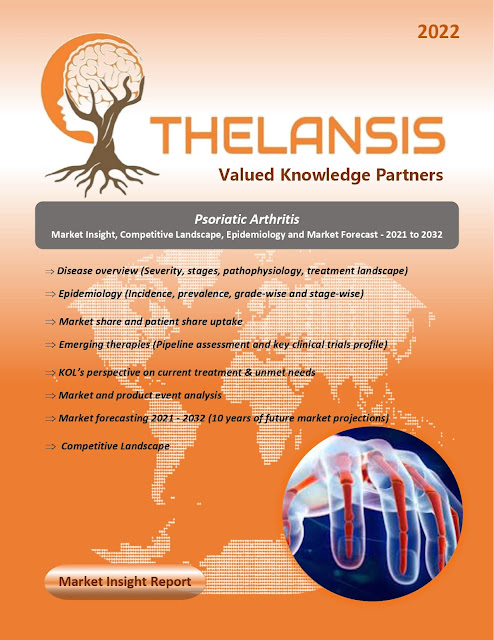
Psoriatic Arthritis– Market Outlook, Epidemiology, Competitive Landscape, and Market Forecast Report – 2021 To 2032

Image
  Psoriatic arthritis (PsA) is a chronic inflammatory autoimmune disease associated with joints and the place where tendons and ligaments are connected to bone and usually occurs in combination with a skin disorder called psoriasis. Enthesitis is one of the most common characteristic features. Other clinical features, including swelling joints, itchy-painful red patches, silvery while building up dead skin cells, and PsA also affect the sacroiliac joint of the pelvic and spine, causing stiffness in and around the neck and back. The exact cause of psoriatic arthritis is still unknown. It starts emerging in individuals aged 30 to 50 and can begin as early as childhood. Both genders are equally at the same risk level. The genetic epidemiology of PsA also supports its unique status. PsA has been associated with human leukocyte antigen (HLA) class 1 alleles as opposed to the class 2 alleles associated with RA. Extra-articular manifestations of PsA are also different from those of RA. In...

Psoriatic Arthritis (PsA) – Market outlook, Epidemiology, Competitive Landscape, and Market Forecast Report – 2021 To 2032

Image
  Psoriatic arthritis (PsA) is a chronic inflammatory autoimmune disease associated with joints and the place where tendons and ligaments are connected to bone and usually occurs in combination with a skin disorder called psoriasis. Enthesitis is one of the most common characteristic features. Other clinical features, including swelling joints, itchy-painful red patches, silvery while building up dead skin cells, and PsA also affect the sacroiliac joint of the pelvic and spine, causing stiffness in and around the neck and back. The exact cause of psoriatic arthritis is still unknown. It starts emerging in individuals aged 30 to 50 and can begin as early as childhood. Both genders are equally at the same risk level. The genetic epidemiology of PsA also supports its unique status. PsA has been associated with human leukocyte antigen (HLA) class 1 alleles as opposed to the type 2 alleles associated with RA. Extra-articular manifestations of PsA are also different from those of RA. In ...