Posts

Showing posts with the label Epithelial Ovarian Cancer market outlook

Epithelial Ovarian Cancer – Market Outlook, Epidemiology, Competitive Landscape, and Market Forecast Report – 2025 To 2035

Epithelial Ovarian Cancer Market Outlook Thelansis’s “Epithelial Ovarian Cancer Market Outlook, Epidemiology, Competitive Landscape, and Market Forecast Report – 2024 To 2034" covers disease overview, epidemiology, drug utilization, prescription share analysis, competitive landscape, clinical practice, regulatory landscape, patient share, market uptake, market forecast, and key market insights under the potential Epithelial Ovarian Cancer treatment modalities options for eight major markets (USA, Germany, France, Italy, Spain, UK, Japan, and China). Key business questions answered: How can drug development and lifecycle management strategies be optimized across G8 markets (US, EU5, Japan, and China)? How large is the patient population in terms of incidence, prevalence, segments, and those receiving drug treatments? What is the 10-year market outlook for sales and patient share? Which events will have the greatest impact on the market’s ...

Epithelial Ovarian Cancer – Market Outlook, Epidemiology, Competitive Landscape, and Market Forecast Report – 2024 To 2034

Epithelial Ovarian Cancer Market Outlook Thelansis’s “Epithelial Ovarian Cancer Market Outlook, Epidemiology, Competitive Landscape, and Market Forecast Report – 2024 To 2034" covers disease overview, epidemiology, drug utilization, prescription share analysis, competitive landscape, clinical practice, regulatory landscape, patient share, market uptake, market forecast, and key market insights under the potential Epithelial Ovarian Cancer treatment modalities options for eight major markets (USA, Germany, France, Italy, Spain, UK, Japan, and China). Epithelial Ovarian Cancer Overview Epithelial ovarian cancer is a neoplastic disease that originates from the epithelial cells that line the ovary and fallopian tubes. It is the most commonly diagnosed histological subtype of ovarian cancer, with a median age of onset between 60 and 65 years. Women under the age of 30 are rarely diagnosed with epithelial ovarian cancer, with the majority of malignancies in this age group being ge...

Epithelial Ovarian Cancer – Market Outlook, Epidemiology, Competitive Landscape, and Market Forecast Report – 2023 To 2033

Image
 Epithelial ovarian cancer is a neoplastic disease that originates from the epithelial cells that line the ovary and fallopian tubes. It is the most commonly diagnosed histological subtype of ovarian cancer, with a median age of onset between 60 and 65 years. Women under the age of 30 are rarely diagnosed with epithelial ovarian cancer, with the majority of malignancies in this age group being germ cell tumors. Symptoms of epithelial ovarian cancer are often nonspecific and include abdominal bloating, early satiety, nausea, abdominal distension, change in bowel function, urinary symptoms, back pain, fatigue, and weight loss. These symptoms typically present months before diagnosis and are more common in the advanced stages of the disease. Ovarian epithelial cancer is divided into two groups, type I and type II. Type I tumors are slow-growing and often found at an early stage, while type II tumors are fast-growing and usually found at an advanced stage. Type I tumors include low-gra...

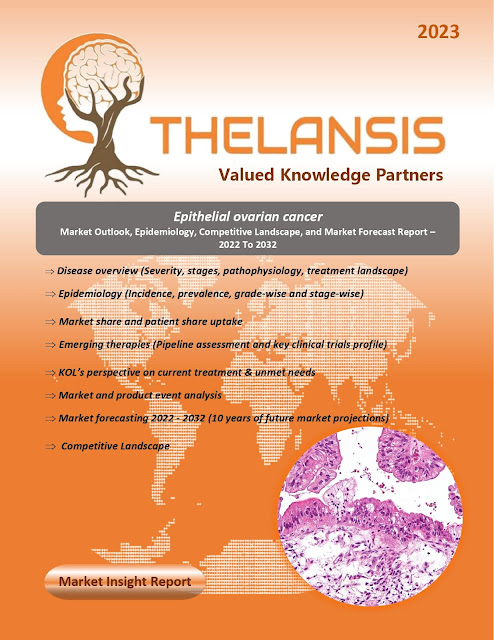
Epithelial Ovarian Cancer – Market Outlook, Epidemiology, Competitive Landscape, and Market Forecast Report – 2022 To 2032

Image
Epithelial ovarian cancer is a neoplastic disease that originates from the epithelial cells that line the ovary and fallopian tubes. It is the most commonly diagnosed histological subtype of ovarian cancer, with a median age of onset between 60 and 65 years. Women under the age of 30 are rarely diagnosed with epithelial ovarian cancer, with the majority of malignancies in this age group being germ cell tumors. Symptoms of epithelial ovarian cancer are often nonspecific and include abdominal bloating, early satiety, nausea, abdominal distension, change in bowel function, urinary symptoms, back pain, fatigue, and weight loss. These symptoms typically present months before diagnosis and are more common in the advanced stages of the disease. Ovarian epithelial cancer is divided into two groups, type I and type II. Type I tumors are slow-growing and often found at an early stage, while type II tumors are fast-growing and usually found at an advanced stage. Type I tumors include low-grade se...