Posts

Showing posts with the label Liver Angiosarcoma market outlook

Liver Angiosarcoma – Market Outlook, Epidemiology, Competitive Landscape, and Market Forecast Report – 2025 To 2035

Liver Angiosarcoma Market Outlook Thelansis’s “Liver Angiosarcoma Market Outlook, Epidemiology, Competitive Landscape, and Market Forecast Report – 2024 To 2034" covers disease overview, epidemiology, drug utilization, prescription share analysis, competitive landscape, clinical practice, regulatory landscape, patient share, market uptake, market forecast, and key market insights under the potential Liver Angiosarcoma treatment modalities options for eight major markets (USA, Germany, France, Italy, Spain, UK, Japan, and China). Key business questions answered: How can drug development and lifecycle management strategies be optimized across G8 markets (US, EU5, Japan, and China)? How large is the patient population in terms of incidence, prevalence, segments, and those receiving drug treatments? What is the 10-year market outlook for sales and patient share? Which events will have the greatest impact on the market’s trajectory? What in...

Liver Angiosarcoma – Market Outlook, Epidemiology, Competitive Landscape, and Market Forecast Report – 2024 To 2034

Liver Angiosarcoma Market Outlook Thelansis’s “Liver Angiosarcoma Market Outlook, Epidemiology, Competitive Landscape, and Market Forecast Report – 2024 To 2034" covers disease overview, epidemiology, drug utilization, prescription share analysis, competitive landscape, clinical practice, regulatory landscape, patient share, market uptake, market forecast, and key market insights under the potential Liver Angiosarcoma treatment modalities options for eight major markets (USA, Germany, France, Italy, Spain, UK, Japan, and China). Liver Angiosarcoma Overview Angiosarcoma is a highly malignant neoplasm originating from the endothelial cells of blood or lymphatic vessels. It is characterized by the formation of abundant vascular channels due to the proliferation of spindle or pleomorphic cells that line or grow into the lumina of preexisting vascular spaces. In adults, primary hepatic angiosarcoma is the liver’s most common primary malignant mesenchymal tumor. The etiology of th...

Liver Angiosarcoma – Market Outlook, Epidemiology, Competitive Landscape, and Market Forecast Report – 2023 To 2033

Image
  Angiosarcoma is a highly malignant neoplasm originating from the endothelial cells of blood or lymphatic vessels. It is characterized by the formation of abundant vascular channels due to the proliferation of spindle or pleomorphic cells that line or grow into the lumina of preexisting vascular spaces. In adults, primary hepatic angiosarcoma is the liver's most common primary malignant mesenchymal tumor. The etiology of the majority of these tumors remains unknown. However, several factors have been identified, including exposure to industrial materials, iatrogenic exposure to certain substances, and chronic ingestion of certain toxins. Hepatic angiosarcoma manifests as a hepatic bleeding mass and can sometimes present as a solid tumor. The tumor tends to metastasize to the lungs and hilar lymph nodes and spread to other organs such as the spleen and bones. Clinical tumour staging is based on the American Joint Committee on Cancer Staging System for soft tissue sarcoma, which c...

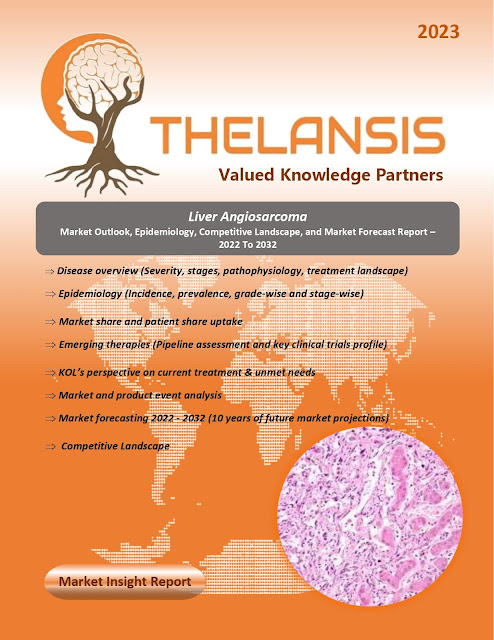
Liver Angiosarcoma – Market Outlook, Epidemiology, Competitive Landscape, and Market Forecast Report – 2022 To 2032

Image
 Angiosarcoma is a highly malignant neoplasm originating from the endothelial cells of blood or lymphatic vessels. It is characterized by the formation of abundant vascular channels due to the proliferation of spindle or pleomorphic cells that line or grow into the lumina of preexisting vascular spaces. In adults, primary hepatic angiosarcoma is the liver's most common primary malignant mesenchymal tumor. The etiology of the majority of these tumors remains unknown. However, several factors have been identified, including exposure to industrial materials, iatrogenic exposure to certain substances, and chronic ingestion of certain toxins. Hepatic angiosarcoma manifests as a hepatic bleeding mass and can sometimes present as a solid tumor. The tumor tends to metastasize to the lungs and hilar lymph nodes and spread to other organs such as the spleen and bones. Clinical tumour staging is based on the American Joint Committee on Cancer Staging System for soft tissue sarcoma, which cons...