Posts

Showing posts with the label Radiation Toxicity market outlook

Radiation Toxicity – Market Outlook, Epidemiology, Competitive Landscape, and Market Forecast Report – 2025 To 2035

Radiation Toxicity Market Outlook Thelansis’s “Radiation Toxicity Market Outlook, Epidemiology, Competitive Landscape, and Market Forecast Report – 2024 To 2034" covers disease overview, epidemiology, drug utilization, prescription share analysis, competitive landscape, clinical practice, regulatory landscape, patient share, market uptake, market forecast, and key market insights under the potential Radiation Toxicity treatment modalities options for eight major markets (USA, Germany, France, Italy, Spain, UK, Japan, and China). Key business questions answered: How can drug development and lifecycle management strategies be optimized across G8 markets (US, EU5, Japan, and China)? How large is the patient population in terms of incidence, prevalence, segments, and those receiving drug treatments? What is the 10-year market outlook for sales and patient share? Which events will have the greatest impact on the market’s trajectory? What in...

Radiation Toxicity – Market Outlook, Epidemiology, Competitive Landscape, and Market Forecast Report – 2024 To 2034

  Radiation Toxicity Market Outlook Thelansis’s “Radiation Toxicity Market Outlook, Epidemiology, Competitive Landscape, and Market Forecast Report – 2024 To 2034" covers disease overview, epidemiology, drug utilization, prescription share analysis, competitive landscape, clinical practice, regulatory landscape, patient share, market uptake, market forecast, and key market insights under the potential Radiation Toxicity treatment modalities options for eight major markets (USA, Germany, France, Italy, Spain, UK, Japan, and China). Radiation Toxicity Overview Radiation toxicity is a significant consideration when it comes to radiotherapy, which is primarily used in treating cancer, arteriovenous malformations in the central nervous system (CNS), and thyroid conditions. Radiotherapy can give rise to both short-term toxicity and long-term consequences. Short-term adverse effects manifest during treatment or within three months afterward, while late effects are observed beyond t...

Radiation Toxicity – Market Outlook, Epidemiology, Competitive Landscape, and Market Forecast Report – 2023 To 2033

Image
  Radiation toxicity is a significant consideration when it comes to radiotherapy, which is primarily used in treating cancer, arteriovenous malformations in the central nervous system (CNS), and thyroid conditions. Radiotherapy can give rise to both short-term toxicity and long-term consequences. Short-term adverse effects manifest during treatment or within three months afterward, while late effects are observed beyond that timeframe. Late effects, such as fibrosis, are generally irreversible and progress over time. The effects of radiation toxicity vary depending on the targeted tissue. Acute-responding tissues, such as haematopoietic and embryonic tissues, hair follicles, and specific intestinal epithelium and dermis layers, have high regenerative capacity and undergo apoptosis to eliminate severely damaged cells. Like the brain, slowly regenerating tissues tend to respond with permanent cell cycle arrest rather than apoptosis. Early adverse effects of radiation-induced tissu...

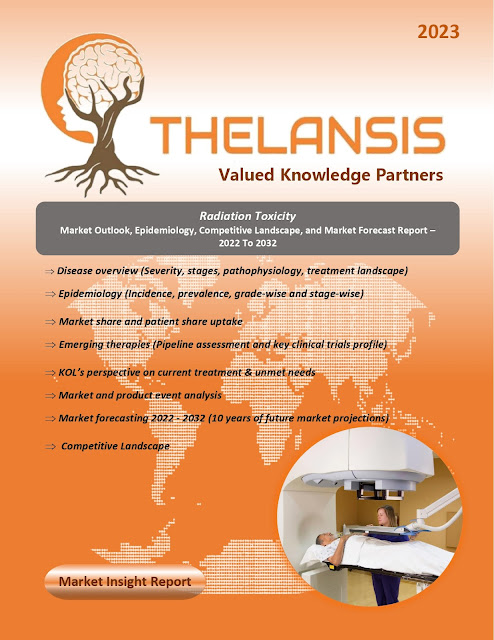
Radiation Toxicity – Market Outlook, Epidemiology, Competitive Landscape, and Market Forecast Report – 2022 To 2032

Image
 Radiation toxicity is a significant consideration when it comes to radiotherapy, which is primarily used in treating cancer, arteriovenous malformations in the central nervous system (CNS), and thyroid conditions. Radiotherapy can give rise to both short-term toxicity and long-term consequences. Short-term adverse effects manifest during treatment or within three months afterward, while late effects are observed beyond that timeframe. Late effects, such as fibrosis, are generally irreversible and progress over time. The effects of radiation toxicity vary depending on the targeted tissue. Acute-responding tissues, such as haematopoietic and embryonic tissues, hair follicles, and specific intestinal epithelium and dermis layers, have high regenerative capacity and undergo apoptosis to eliminate severely damaged cells. Like the brain, slowly regenerating tissues tend to respond with permanent cell cycle arrest rather than apoptosis. Early adverse effects of radiation-induced tissue d...