Posts

Showing posts with the label Chronic Gout market forecast

Chronic Gout – Market Outlook, Epidemiology, Competitive Landscape, and Market Forecast Report – 2025 To 2035

Chronic Gout Market Outlook Thelansis’s “Chronic Gout Market Outlook, Epidemiology, Competitive Landscape, and Market Forecast Report – 2024 To 2034" covers disease overview, epidemiology, drug utilization, prescription share analysis, competitive landscape, clinical practice, regulatory landscape, patient share, market uptake, market forecast, and key market insights under the potential Chronic Gout treatment modalities options for eight major markets (USA, Germany, France, Italy, Spain, UK, Japan, and China). Key business questions answered: How can drug development and lifecycle management strategies be optimized across G8 markets (US, EU5, Japan, and China)? How large is the patient population in terms of incidence, prevalence, segments, and those receiving drug treatments? What is the 10-year market outlook for sales and patient share? Which events will have the greatest impact on the market’s trajectory? What insights do intervie...

Chronic Gout – Market Outlook, Epidemiology, Competitive Landscape, and Market Forecast Report – 2024 To 2034

Chronic Gout Market Outlook Thelansis’s “Chronic Gout Market Outlook, Epidemiology, Competitive Landscape, and Market Forecast Report – 2024 To 2034" covers disease overview, epidemiology, drug utilization, prescription share analysis, competitive landscape, clinical practice, regulatory landscape, patient share, market uptake, market forecast, and key market insights under the potential Chronic Gout treatment modalities options for eight major markets (USA, Germany, France, Italy, Spain, UK, Japan, and China). Chronic Gout Overview Gout is a disorder of purine metabolism that causes hyperuricemia and generally refers to a form of arthritis. The first symptoms include intense pain in only one hallux joint in 90% of the cases. The elevated blood uric acid level in men (serum-urate level >7 mg/dl) and in women (serum-urate level >6) results in the formation of monosodium urate (MSU) crystals and deposition in joint bones and subcutaneous tissue. Hyperuricemia is not the ...

Chronic Gout – Market Outlook, Epidemiology, Competitive Landscape, and Market Forecast Report – 2023 To 2033

Image
  Gout is a disorder of purine metabolism that causes hyperuricemia and generally refers to a form of arthritis. The first symptoms include intense pain in only one hallux joint in 90% of the cases. The elevated blood uric acid level in men (serum-urate level >7 mg/dl) and in women (serum-urate level >6) results in the formation of monosodium urate (MSU) crystals and deposition in joint bones and subcutaneous tissue. Hyperuricemia is not the only factor for gout. Other factors are also implicated in gouts, such as age, gender, obesity, alcohol consumption, medication, comorbid disease, genetics, and purine diet. Hyperuricaemia and gout can be considered over four pathological stages: development of hyperuricemia, deposition of monosodium urate crystals, the clinical presentation of gout flares due to an acute inflammatory response to deposited crystals, and clinical presentation of an advanced disease characterized by tophi. The estimated prevalence of gout in U.S. a...

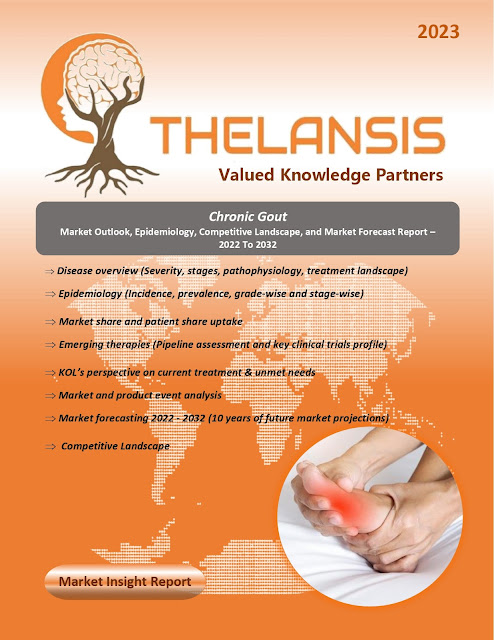
Chronic Gout – Market Outlook, Epidemiology, Competitive Landscape, and Market Forecast Report – 2022 To 2032

Image
 Gout is a disorder of purine metabolism that causes hyperuricemia and generally refers to a form of arthritis. The first symptoms include intense pain in only one hallux joint in 90% of the cases. The elevated blood uric acid level in men (serum-urate level >7 mg/dl) and in women (serum-urate level >6) results in the formation of monosodium urate (MSU) crystals and deposition in joint bones and subcutaneous tissue. Hyperuricemia is not the only factor for gout. Other factors also implicated in gouts, such as age, gender, obesity, alcohol consumption, medication, comorbid disease, genetics, and purine diet. Hyperuricaemia and gout can be considered over four pathological stages development of hyperuricemia, deposition of monosodium urate crystals, the clinical presentation of gout flares due to an acute inflammatory response to deposited crystals, and clinical presentation of an advanced disease characterized by tophi. ·        The estimated pr...

Chronic Gout – Market Outlook, Epidemiology, Competitive Landscape, and Market Forecast Report – 2022 To 2032

Image
 Gout is a disorder of purine metabolism that causes hyperuricemia and generally refers to a form of arthritis. The first symptoms include intense pain in only one hallux joint in 90% of the cases. The elevated blood uric acid level in men (serum-urate level >7 mg/dl) and in women (serum-urate level >6) results in the formation of monosodium urate (MSU) crystals and deposition in joint bones and subcutaneous tissue. Hyperuricemia is not the only factor for gout. Other factors also implicated in gouts, such as age, gender, obesity, alcohol consumption, medication, comorbid disease, genetics, and purine diet. Hyperuricaemia and gout can be considered over four pathological stages development of hyperuricemia, deposition of monosodium urate crystals, the clinical presentation of gout flares due to an acute inflammatory response to deposited crystals, and clinical presentation of an advanced disease characterized by tophi. ·        The estimated pr...